
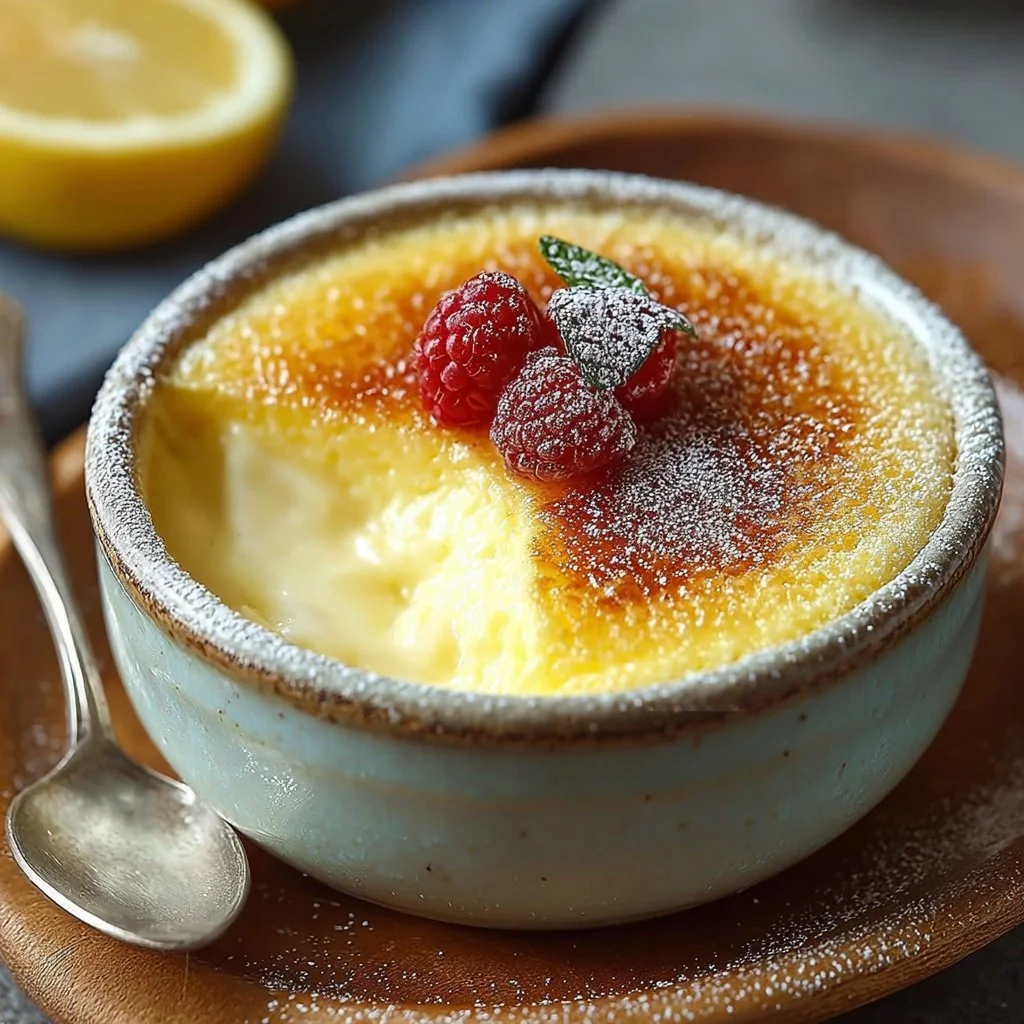
The first time I made this lemon pudding it came out like a sunny hug — silky, tangy and impossibly simple.
It’s one of those recipes that looks fancy on the table but takes surprisingly little fuss.
If you want a dessert that travels well from weekday supper to weekend dinner party, this is that dessert.
What makes it a winner is the balance: bright lemon, soft custard texture and a whisper of butter that keeps it rich without being cloying.
You can scale it up or down, and it responds beautifully to small tweaks like extra zest or a scattering of berries.
Why You’ll Love This Recipe
- Bright lemon flavor that isn’t overwhelmingly tart.
- Custardy, tender texture that cuts clean when spooned.
- One-bowl assembly, minimal equipment, ideal for home cooks.
- Great make-ahead dessert — tastes even better after a short rest.
This pudding hits that magical middle ground between a lemon posset and a light baked custard.
The eggs give structure, the milk keeps it tender, and fresh lemon juice sharpens the profile so each spoonful feels lively, not heavy.
"Absolutely delicious — the pudding was silky, lemony and disappeared in minutes. My guests thought I’d been slaving away!" — 5★ reader review
Key Ingredients
Eggs (4 large)
Eggs are the backbone of the pudding. They coagulate as the pudding bakes, creating a delicate, custard-like set. Use large eggs at room temperature for best emulsification and consistent texture.
Fresh lemon juice (1/2 cup) + Zest of 2 lemons
Fresh lemon juice delivers bright acidity and real citrus flavor that bottled juice can’t match. The zest carries essential oils that make the pudding aromatic — don’t skip it. Choose unwaxed lemons or scrub well.
Whole milk (1 cup)
Whole milk adds creaminess and richness while keeping the mixture light. If you need a richer custard, swap half the milk for a splash of cream, but whole milk gives a lovely, balanced mouthfeel.
Unsalted butter (1/4 cup), melted
Butter rounds out the lemon’s sharpness and adds silkiness. Use unsalted so you control salt levels; a good quality European-style butter will amplify flavor with less quantity.
Full ingredient list:
- 4 large eggs
- 1 cup granulated sugar
- 1 cup whole milk
- 1/2 cup fresh lemon juice (about 2–3 lemons)
- Zest of 2 lemons
- 1/4 cup unsalted butter, melted
- 1 teaspoon vanilla extract
- Pinch of salt
- Powdered sugar, for dusting (optional)
- Fresh berries, for garnish (optional)
Step-by-Step Instructions
Step 1: Preheat and prepare your dish
Preheat your oven to 350°F (175°C).
Lightly grease a medium-sized baking dish or spray with nonstick baking spray.
You’ll know it’s ready when the oven reaches temperature and the dish is lightly coated.
Pro Tip: Use a shallow, even-sided dish so the pudding bakes uniformly.
Step 2: Whisk eggs and sugar
Crack the eggs into a mixing bowl and add the granulated sugar.
Whisk until the mixture becomes pale and fluffy — this incorporates air and helps the pudding set with a tender texture.
You’ll notice the color lighten and the mixture gain volume; that’s the cue to move on.
Pro Tip: If you have a hand mixer, whisk on medium for 2–3 minutes. For a whisk only, be patient — the change is subtle but important.
Step 3: Add milk and melted butter
Gradually pour in the whole milk while whisking to combine.
Slowly add the melted butter so it emulsifies into the egg mixture rather than pooling.
The batter should feel smooth and slightly silky when it’s ready.
Pro Tip: Ensure the melted butter isn’t piping hot; warm or room temperature prevents curdling.
Step 4: Incorporate lemon juice, zest, vanilla and salt
Stir in the fresh lemon juice, lemon zest, vanilla extract, and a pinch of salt.
Mix until everything is evenly combined and the batter smells bright and citrusy.
Taste a tiny bit (it’s safe since there are raw eggs) to check the lemon-sugar balance; adjust if you like a zestier tang.
Pro Tip: Add lemon juice gradually if you prefer a milder lemon flavor — you can always add more.
Step 5: Transfer to baking dish and set up a water bath
Pour the lemon mixture into the prepared baking dish.
Place that dish inside a larger roasting pan and carefully pour hot water into the pan until it reaches halfway up the sides of the baking dish.
This water bath ensures gentle, even cooking and prevents the edges from overcooking.
Pro Tip: Use boiling water for the bath but handle carefully to avoid splashes. The water should be hot enough to create a moist oven environment.
Step 6: Bake until just set
Place the roasting pan in the preheated oven and bake for 30–35 minutes.
The pudding is done when the center is set but still has a slight wobble and the top is lightly golden.
A toothpick inserted near the center should come out mostly clean with a few moist crumbs.
Pro Tip: If the top browns too quickly, tent loosely with foil for the last 10 minutes of baking.
Step 7: Cool and finish
Remove the baking dish from the water bath and let it cool on a wire rack for 15–20 minutes.
The pudding will continue to set as it cools and will hold a clean spoonful once it’s slightly warm.
Dust with powdered sugar and scatter fresh berries before serving, if desired.
Pro Tip: For a cleaner slice, chill for 30–60 minutes and use a hot, dry knife between slices.
By following these steps, you’ll create a delicious Jamie Oliver Lemon Pudding that’s sure to impress.

Expert Tips for Success
- Temperature matters: Use room-temperature eggs and lukewarm melted butter to help the ingredients emulsify smoothly and avoid curdling. Cold eggs can cause uneven texture.
- Fresh lemon over bottled: Always use fresh lemon juice and zest. The volatile oils in fresh zest transform the aroma and depth of the pudding more than extra sugar ever will.
- Water bath technique: Don’t skimp on the water in the roasting pan. The gentle steam prevents the custard from cracking and creates that silky texture. Bring the water to hot but not boiling and pour it carefully.
- Watch doneness, not time: Ovens vary — rely on the jiggle test. When the center has a slight wobble, it’s done. Overbaking makes the pudding dry and rubbery.
- Use a shallow dish: A wider, shallower dish reduces bake time and gives a more consistent set. If you only have a deep dish, check 5–10 minutes earlier than the recipe time.
- Flavor balance: If the lemon is too sharp after baking, a dusting of powdered sugar or a dollop of lightly sweetened whipped cream calms the acidity and enhances mouthfeel.
- Make-ahead tip: The pudding can be baked a day ahead and kept lightly covered in the fridge. Bring to room temperature or gently rewarm before serving for a smoother finish.
- Scaling the recipe: To double, use a larger pan and increase the baking time slightly while watching the jiggle. For individual portions, use ramekins and reduce baking time to 18–22 minutes, checking for set.
- Equipment suggestion: A silicone spatula for folding and a shallow ceramic or glass baking dish for even heat distribution will improve results. Avoid metal dishes that can over-conduct heat to edges.
- Troubleshooting curdling: If your batter shows lumps after adding butter, whisk vigorously and pass through a fine mesh sieve to remove any bits before baking.
Storage & Freezing
Fridge storage: Cool the pudding completely, then cover tightly with plastic wrap or place in an airtight container.
It will keep in the refrigerator for up to 3 days without losing much texture.
Reheating from fridge: Warm gently in a 300°F (150°C) oven for 10–15 minutes until just warm.
Alternatively, microwave single servings in 10–15 second bursts, stirring between blasts to avoid hot spots.
Freezing: You can freeze individual portions. Wrap tightly in plastic wrap and then foil, or use a freezer-safe container.
Freeze for up to 2 months. Thaw overnight in the refrigerator before reheating gently.
Reheating from frozen: Thaw completely in the fridge, then warm in a low oven (275–300°F / 135–150°C) for 15–20 minutes.
Avoid high heat — it will cause the custard to weep and become grainy.
Notes on texture after storage: The pudding firms slightly when chilled, so serve at room temperature for the best mouthfeel.
If the surface exudes a little liquid after reheating, a quick whisk or stir will reincorporate it.
Variations & Substitutions
Lemon-Blueberry Pudding: Fold 1 cup fresh or frozen blueberries into the batter before baking.
The berries add sweet bursts and pair beautifully with the lemon; use smaller berries to avoid weighing down the custard.
Lime or Orange swap: Swap lemon juice and zest with lime or orange for a citrus twist.
Lime gives a sharper profile, orange softens the acidity and adds floral notes.
Lower-dairy version: Replace half the whole milk with almond milk or oat milk for a lighter dairy footprint.
Texture will be a touch less rich; add a tablespoon of cornstarch if you want more body.
Gluten-free crust option: For a different presentation, pour the batter into a pre-baked gluten-free shortcrust or graham base and bake the same.
This turns the pudding into a tart-like dessert with a crunchy contrast.
Sweetener swaps: For less refined sugar, try coconut sugar or 3/4 cup honey, reducing other sweet elements slightly.
Note that color and flavor will shift with different sweeteners.
Frequently Asked Questions
Q: Can I make this pudding without eggs?
A: Eggs are crucial for the custard’s set and silky texture. For an egg-free version, consider a lemon posset that uses cream, sugar, and lemon juice to thicken through acid — but it will be a different texture.
Q: My pudding cracked on top — what went wrong?
A: Cracking usually means the oven was too hot or it was baked too long. Use a water bath and remove when the center still jiggles slightly to avoid overbaking.
Q: How tart will this be — can I reduce the lemon?
A: The recipe balances tart and sweet, but you can reduce the lemon juice slightly for a milder flavor. Keep the zest for aroma, as it doesn’t add the same acidity.
Q: Can I bake this in individual ramekins?
A: Yes. Ramekins work beautifully and make pretty individual servings. Reduce bake time to 18–22 minutes, checking for a slight wobble.
Q: What’s the best way to serve it at a dinner party?
A: Serve slightly warm with a light dusting of powdered sugar and fresh berries or a spoonful of mascarpone. Chill for elegant slices or serve warm for a homey, comforting finale.
Final Thoughts
This Jamie Oliver–style lemon pudding is an easy, impressive dessert that rewards small, quality choices like fresh lemons and room-temperature eggs.
Give it a go — it’s perfect for weeknights and company alike.
Please leave a star rating in the recipe card below and pin this to Pinterest if you enjoyed it.
Conclusion
If you like classic British comfort desserts, you might enjoy trying a hearty roast like Slow cooked lamb shoulder | Jamie Oliver lamb recipes as a main for your dinner party.
For a different sort of bake, these techniques pair well with recipes like The Best Yorkshire Pudding Recipe, and Jamie’s own take on light puddings is echoed in his Easy Yorkshire pudding recipe | Jamie Oliver recipes.
If you’re feeding different eaters, try a plant-forward option like the Monster Vegan Burger by Ellie Goulding and Jamie Oliver for a lively vegetarian main to pair with this lemony finish.

Lemon Pudding
Ingredients
Base Ingredients
- 4 large large eggs Use room temperature for best results.
- 1 cup granulated sugar
- 1 cup whole milk Can substitute half with cream for richer texture.
- 1/2 cup fresh lemon juice About 2-3 lemons required.
- 2 pcs zest of lemons Choose unwaxed lemons or scrub well.
- 1/4 cup unsalted butter, melted Use high-quality butter for best flavor.
- 1 teaspoon vanilla extract
- 1 pinch salt
- powdered sugar, for dusting (optional)
- fresh berries, for garnish (optional)
Instructions
Preparation
- Preheat your oven to 350°F (175°C). Grease a medium-sized baking dish.
Mixing
- In a mixing bowl, whisk together the eggs and granulated sugar until pale and fluffy.
- Gradually add whole milk while whisking, then add melted butter and mix until smooth.
- Stir in fresh lemon juice, lemon zest, vanilla extract, and a pinch of salt.
Baking
- Set the dish in a larger roasting pan and fill with hot water halfway up the sides.
- Bake for 30-35 minutes until set but still has a slight wobble.
Cooling and Serving
- Remove from the oven and let cool for 15-20 minutes. Dust with powdered sugar and add fresh berries before serving.


