
The first time I made this Korean winter soup I woke up my whole apartment with the smell of simmering beef and roasted garlic.
It’s the kind of bowl that feels like a blanket — warming, simple, and deeply savory.
This recipe balances rich beef broth with crisp napa and soft radish so every spoonful has texture and warmth.
It’s forgiving, fridge-friendly, and brilliant for batch cooking on chilly nights.
Why You’ll Love This Recipe
- Deep, beef-forward flavor without a full-day simmer.
- Crunch and silk: mu (Korean radish) keeps a bright bite while napa folds into the broth.
- Quick assembly with pantry-friendly seasonings — perfect for weeknight comfort.
- Easily scaled, frozen, or customized with heat level and mushroom choice.
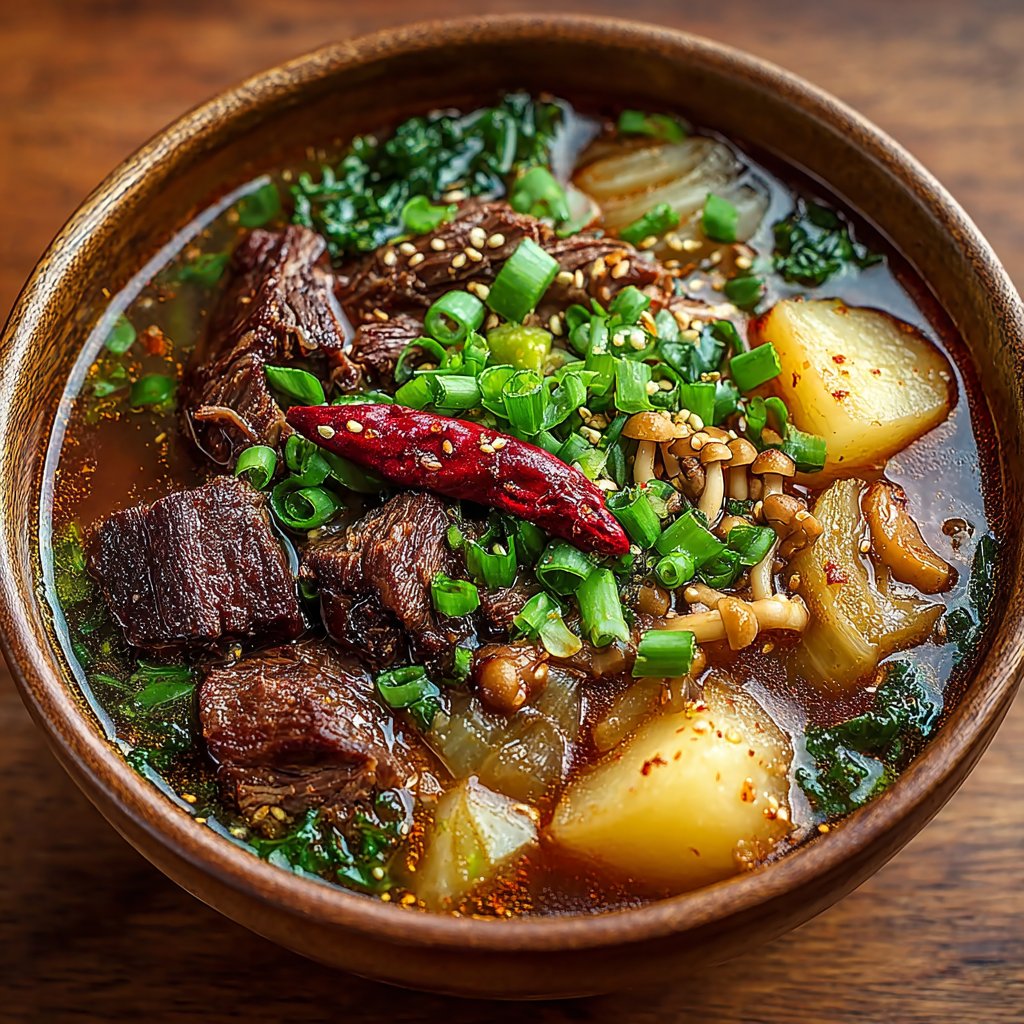
The texture is layered: the brisket or shank becomes fork-tender and yields a rich, collagen-slick mouthfeel.
The radish gives a subtle crunch the first few minutes and then softens to release a faint sweetness.
Cabbage absorbs the broth and becomes almost silky, while mushrooms add an earthy chew that rounds the beef.
“Five stars — I made this for a blustery evening and it was exactly what my family needed. Simple ingredients, huge comfort.” — reader Jina K.
Key Ingredients
Beef (brisket or shank) — Choose a cut with some connective tissue like brisket or shank.
Those bits of collagen melt into the broth during simmering and give the soup that silky mouthfeel that makes it feel luxurious.
If you can, buy from a butcher who will trim but leave a little fat — it improves flavor without being greasy.
Beef broth — Use a high-quality store-bought broth or homemade beef stock for depth.
A low-sodium, full-flavored broth is ideal because you control salt with soy sauce later.
If buying, brands like Kettle & Fire or a trusted local stock will give cleaner beef notes.
Korean radish (mu) — Mu adds both texture and a mild peppery-sweet flavor that cuts the richness.
Slice it fairly thick so it holds together through the 30-minute simmer; it shouldn’t turn to mush.
If you can’t find mu, a daikon radish is an acceptable substitute but taste may be slightly milder.
Gochugaru (Korean red pepper flakes) — This is the chili that adds the Korean signature touch.
Start with 1 tablespoon and adjust; good gochugaru (like Chung Jung One or Sempio) has bright, slightly smoky heat rather than pure fire.
It blends into the broth rather than overpowering, giving a warm red color and gentle peppery lift.
Full ingredient list:
- 1 lb beef (brisket or shank), cut into pieces
- 8 cups beef broth
- 2 cups water
- 1 medium onion, sliced
- 3 cloves garlic, minced
- 1 cup Korean radish (mu), sliced
- 2 cups napa cabbage, chopped
- 1 cup mushrooms (shiitake or enoki)
- 2 green onions, sliced
- 1-2 tablespoons gochugaru (Korean red pepper flakes)
- Salt and pepper to taste
- Soy sauce to taste
- Sesame oil (optional)
Step-by-Step Instructions
Step 1: Build the broth and start the simmer
Place the beef pieces into a large pot and pour in 8 cups of beef broth plus 2 cups of water.
Bring the pot up to a rolling boil over high heat, then immediately reduce to a gentle simmer.
Skim any foam or impurities that rise to the surface with a ladle—this keeps the broth clear and clean-tasting.
Pro Tip: You’ll know the skim is done when the surface stays mostly clear and the broth smells beefy-not-bitter.
Step 2: Add aromatics and radish
Add the sliced onion, minced garlic, and the sliced Korean radish to the simmering pot.
Keep the heat at a low simmer—too high and the broth clouds; too low and the beef won’t tenderize efficiently.
Simmer for about 30 minutes, testing the meat for tenderness; the beef should yield easily with a fork.
Pro Tip: The radish should be fork-tender but still intact after 30 minutes; if it’s falling apart, cut thicker next time.
Step 3: Finish with cabbage and mushrooms
Stir in the chopped napa cabbage and your chosen mushrooms (shiitake or enoki).
Let the pot cook for an additional 15–20 minutes, until the cabbage wilts into the broth and mushrooms soften.
This stage is about melding textures — the cabbage soaks up flavor while the mushrooms contribute earthiness.
Pro Tip: Add enoki in the last 5 minutes to keep delicate strands intact; shiitake can go in a bit earlier for deeper flavor.
Step 4: Season to taste
Remove the pot briefly from heat and season with gochugaru, salt, black pepper, and a splash of soy sauce.
Taste frequently — the aim is balanced heat, salt, and umami. Adjust with another half teaspoon of soy if it needs depth.
If you like a hint of fragrance, drizzle a little sesame oil just before serving.
Pro Tip: Add gochugaru gradually. Its color is dramatic but the heat is moderate — you can always add more.
Step 5: Serve and garnish
Ladle the hot soup into bowls and scatter sliced green onions on top.
Offer extra gochugaru and soy sauce at the table so guests can adjust.
Serve with steamed rice or a few kimchi side dishes for contrast.
Pro Tip: The soup tastes even better after resting 10–15 minutes; flavors meld and the broth rounds out.
Expert Tips for Success
-
Use the right cut of beef: brisket and shank convert connective tissue to gelatin as they simmer.
This gives the broth body without needing hours of pressure cooking. -
Control the boil: always maintain a gentle simmer after the initial boil.
Vigorous boiling breaks down proteins too aggressively and clouds both texture and flavor. -
Skim well and early: the first 10–20 minutes produce the most foam.
A clean skim prevents bitterness and gives clearer broth that tastes fresher. -
Layer your seasoning: add small amounts of soy and gochugaru, then adjust at the end.
Salt early in small increments, then finish with soy for umami and a final salt check. -
Choose fresh mu and napa: radish should be firm and white with no soft spots.
Napa leaves should be crisp; limp or yellowed leaves will make the broth dull. -
Temperature matters when reheating: reheat gently over low heat so collagen and fat don’t separate.
Rapid reheating can make the broth greasy or break the soft textures. -
Equipment choice: a heavy-bottomed pot holds even heat and reduces the need for frequent stirring.
If using a pressure cooker, cut simmer time and check for over-soft radish. -
Mushroom strategy: dried shiitake add concentrated umami when rehydrated in warm water.
Reserve the soaking liquid (strained) to deepen your broth if using dried mushrooms. -
Balance the heat: gochugaru gives color and warmth, but you can mix in a teaspoon of toasted sesame paste for a richer mouthfeel if you want a creamier finish.
Storage & Freezing
Fridge: Cool the soup to room temperature within 2 hours, then store in airtight containers.
Use within 3–4 days for best texture and flavor. Reheat on the stovetop over low heat until steaming.
Freezer: For longer storage, portion the soup (leave space for expansion) into freezer-safe containers.
Freeze up to 3 months. If including cabbage, I recommend freezing in portions — cabbage softens after thawing but still works well in cooked soups.
Thawing & Reheating: Thaw overnight in the fridge or use the microwave defrost setting.
Reheat slowly on the stove over low heat, stirring occasionally. Add a splash of water or broth if the soup seems too concentrated.
Reconstituting texture: If cabbage or mushrooms become too soft after freezing, refresh with a handful of fresh napa or a few quick-sauteed mushrooms when reheating.
Variations & Substitutions
Beef-free version: Substitute beef with firm tofu and use vegetable broth.
Add toasted sesame oil and extra mushrooms to maintain umami.
Spicy beef version: Increase gochugaru and add a tablespoon of Korean chili paste (gochujang) dissolved in some hot broth for a deeper, savory heat.
Seafood twist: Replace beef with a firm white fish and add clams for briny notes.
Use a lighter broth and add greens late so they remain crisp.
Quick weeknight shortcut: Use rotisserie chicken and chicken broth, keeping the rest of the vegetables the same for a fast, comforting bowl.
Frequently Asked Questions
Q: Can I make this in a slow cooker?
A: Yes. Brown the beef briefly on the stovetop for better flavor, then add to a slow cooker with the broth, water, onion, garlic, and radish.
Cook on low 6–8 hours or high 3–4 hours. Add cabbage and mushrooms in the final 20–30 minutes.
Q: How do I reduce fat in the soup?
A: Trim excess fat from the beef before cooking and refrigerate the finished soup; hardened fat can be skimmed from the top before reheating.
Using leaner cuts will reduce richness but may sacrifice some mouthfeel.
Q: Is gochugaru the same as chili flakes?
A: Not exactly. Gochugaru has a coarser grind and a fruity, smoky sweetness specific to Korean cuisine.
Regular red pepper flakes are hotter and will change the flavor profile; use less if substituting.
Q: Can I add noodles to this soup?
A: Yes—wheat noodles or rice noodles can be cooked separately and added to bowls before ladling soup over them.
If you cook noodles in the soup, they will absorb liquid and can make the broth starchy over time.
Q: Why is my broth cloudy?
A: A rapidly boiling pot, not skimming early, or not rinsing bone/meat pieces can cloud broth.
Maintain a gentle simmer and skim foam during the first 10–20 minutes for a clearer result.
Final Thoughts
This Korean winter soup is straightforward, adaptable, and consistently comforting.
It’s a recipe you can tweak easily while keeping that deep, savory backbone that makes it feel like home.
Please leave a star rating in the recipe card below if you try it, and pin this to Pinterest for the next cold night.
Conclusion
For more inspiration on Korean winter soups, check out Kimchimari’s Korean winter soup round-up which highlights regional favorites.
If you want variety beyond this recipe, explore My Korean Kitchen’s soup and stew collection for classic and modern takes.
For a spicy beef noodle variation that complements this soup style, try Jeanette’s spicy Korean beef noodle soup recipe.
And for cultural context on why Koreans lean on soups in winter, read E.A.T.’s Winter Soups in Korea article.
Korean Winter Soup
Ingredients
Main Ingredients
- 1 lb beef (brisket or shank), cut into pieces Choose a cut with some connective tissue.
- 8 cups beef broth Use high-quality store-bought or homemade broth.
- 2 cups water
- 1 medium onion, sliced
- 3 cloves garlic, minced
- 1 cup Korean radish (mu), sliced Slice fairly thick.
- 2 cups napa cabbage, chopped
- 1 cup mushrooms (shiitake or enoki) Use shiitake for deeper flavor, add enoki last for texture.
- 2 each green onions, sliced For garnish.
- 1-2 tablespoons gochugaru (Korean red pepper flakes) Adjust to taste.
- Salt and pepper to taste
- Soy sauce to taste
- Sesame oil (optional) For finishing touch.
Instructions
Build the Broth and Start the Simmer
- Place the beef pieces into a large pot and pour in 8 cups of beef broth plus 2 cups of water.
- Bring the pot to a rolling boil over high heat, then immediately reduce to a gentle simmer.
- Skim any foam or impurities that rise to the surface with a ladle.
Add Aromatics and Radish
- Add the sliced onion, minced garlic, and the sliced Korean radish to the simmering pot.
- Keep the heat at a low simmer for about 30 minutes, testing the meat for tenderness.
Finish with Cabbage and Mushrooms
- Stir in the chopped napa cabbage and your chosen mushrooms.
- Let the pot cook for an additional 15–20 minutes.
Season to Taste
- Remove the pot from heat and season with gochugaru, salt, black pepper, and a splash of soy sauce.
Serve and Garnish
- Ladle the hot soup into bowls and scatter sliced green onions on top.