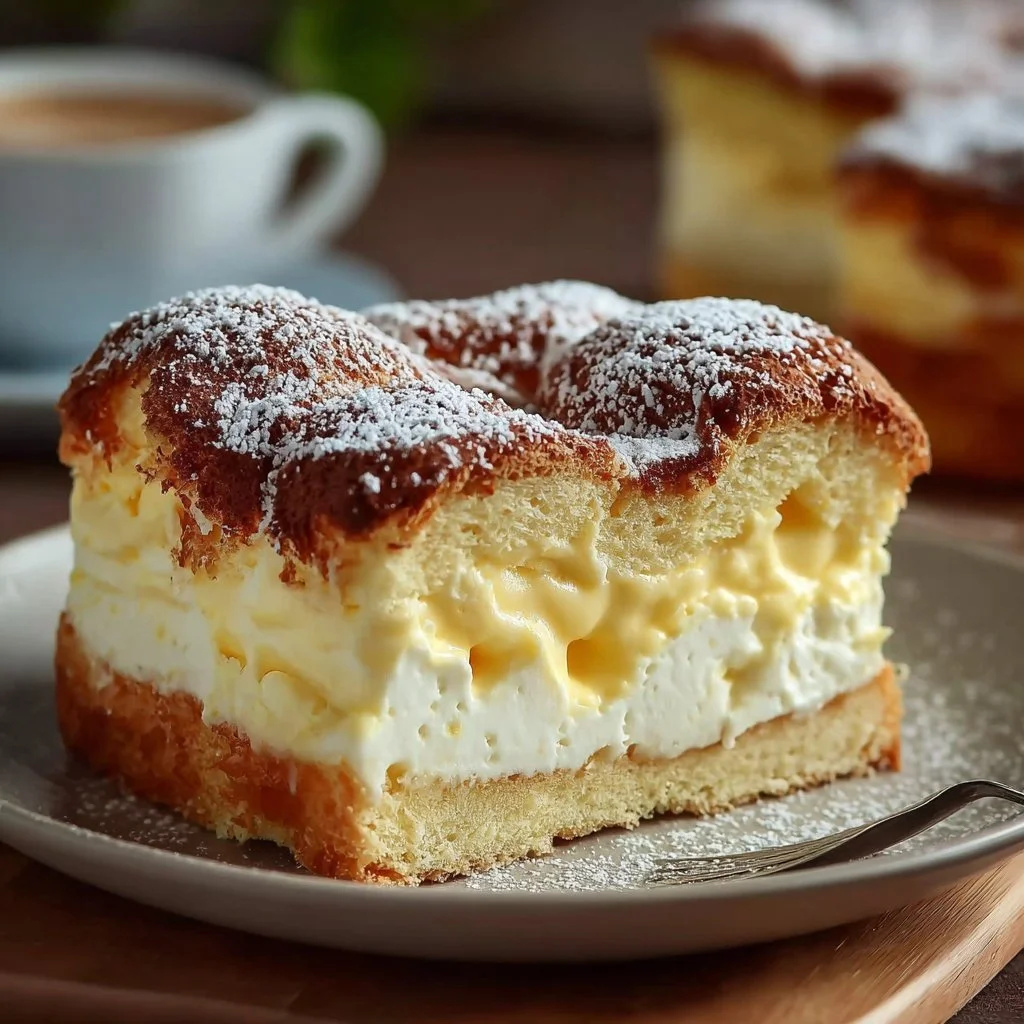
The first time I made this Karpatka, I remember the pastry puffing up like two golden islands and the custard settling between them like a soft, vanilla cloud.
If you are looking for a showstopping dessert that still feels homey, this Heavenly Karpatka Cake delivers on texture, taste, and nostalgia.
It feeds about eight people, comes together from simple pantry staples, and rewards a little patience with a dessert that looks and tastes far fancier than the effort required.
Why You’ll Love This Recipe
- Iconic contrast: crisp, choux-like pastry layered with lusciously smooth custard.
- Simple ingredients: no specialty items required — mostly flour, eggs, milk, and butter.
- Crowd-pleaser: elegant enough for guests, comforting enough for family dinners.
- Make-ahead friendly: components can be prepared in advance for easy assembly.
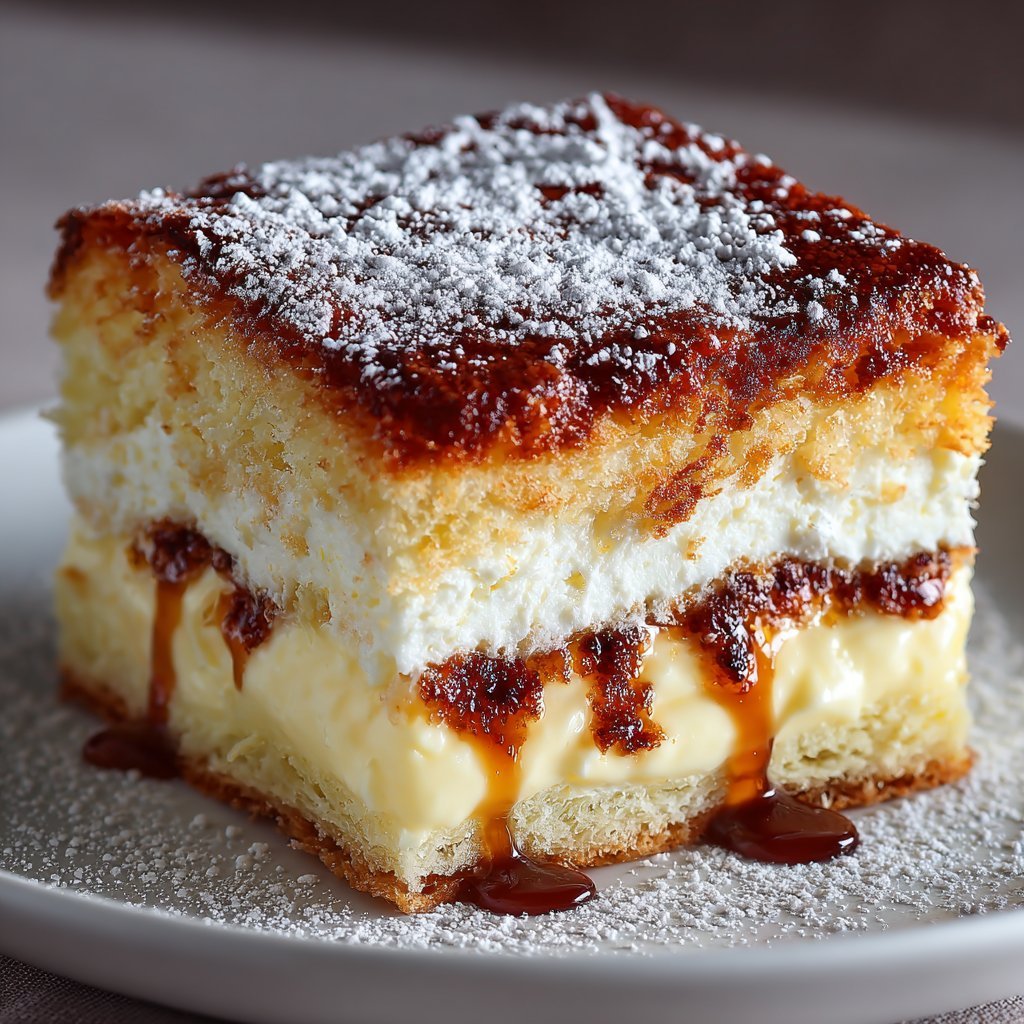
The texture is the real joy here: the baked pastry layers have an irregular, craggy top that gives a light crunch and a dry, bready interior that soaks just enough of the custard to become tender without collapsing. The custard is silky, thick, and vanilla-forward, cutting through the pastry’s slight richness with a clean, creamy finish.
“My guests thought I bought it at a bakery. This karpatka is now my signature dessert — perfectly balanced and ridiculously easy.” — Emma, 5★
Key Ingredients
Unsalted butter
High-quality unsalted butter is essential for both the pastry and the custard. The butter provides richness and a glossy finish in the pastry dough and smoothness in the custard; use a European-style butter if you prefer a slightly deeper flavor.
Large eggs
Eggs are the engine of the pastry—adding structure and steam that puffs the dough. Use room-temperature eggs so they emulsify properly into the cooled dough; cold eggs can cause the dough to seize.
Whole milk
Whole milk gives the custard a creamy mouthfeel and helps it set properly with cornstarch. Avoid skim or low-fat milk unless you adjust the cornstarch and expect a thinner filling.
Cornstarch
Cornstarch is the thickener that yields a silky, stable custard without the gumminess that sometimes comes from too much flour. Measure carefully and whisk thoroughly to avoid lumps.
Full ingredient list:
- For the Pastry:
- 1 cup all-purpose flour
- ½ cup unsalted butter
- ½ cup water
- 4 large eggs
- 1 tablespoon sugar
- 1 pinch of salt
- For the Custard Filling:
- 2 cups milk
- ½ cup granulated sugar
- 3 tablespoons cornstarch
- 4 large egg yolks
- 1 teaspoon vanilla extract
- 2 tablespoons unsalted butter
- For Topping:
- Powdered sugar (for dusting)
Step-by-Step Instructions
Step 1: Preheat and prepare
Preheat your oven to 375°F (190°C).
Grease a baking sheet or line it with parchment for easier release.
Pro Tip: Use an oven thermometer for accuracy; 375°F on a dial oven can be off by 10–25°F.
Step 2: Make the pastry dough (pâte à choux style)
In a saucepan combine ½ cup water, ½ cup unsalted butter, 1 tablespoon sugar, and a pinch of salt.
Bring it to a rolling boil so the butter fully melts and the mixture is steaming.
Remove the pan from the heat and immediately stir in 1 cup all-purpose flour until a smooth dough forms.
Return briefly to low heat while stirring to dry the dough slightly—this helps the eggs incorporate.
Pro Tip: The dough should form a glossy ball that pulls away from the pan. If it’s too wet, cook a few seconds longer to evaporate excess moisture.
Step 3: Incorporate the eggs
Let the dough cool for 3–5 minutes, just enough so it’s warm but not piping hot.
Add 4 large eggs one at a time, beating or stirring vigorously after each addition until fully combined.
The batter should become smooth, glossy, and pliable—thicker than pancake batter but spoonable.
Pro Tip: If the batter looks curdled after an egg, keep mixing; it usually comes back together. Add the eggs at room temperature for best emulsion.
Step 4: Divide and spread the dough
Divide the dough in half using a spatula or scale for even layers.
Spread one half evenly onto a greased or parchment-lined baking sheet to form the first layer, aiming for an even thickness—roughly the size of your final cake.
Repeat the same with the second half on a separate sheet or bake sequentially.
Pro Tip: The natural peaks and valleys are perfect—don’t over-smooth. They give Karpatka its characteristic look and extra crispness on top.
Step 5: Bake the pastry layers
Bake each layer in the preheated oven for about 20–25 minutes, or until golden brown.
Let the layers cool completely on a wire rack before attempting to assemble.
You’ll know it’s ready when the surface is golden and dry to the touch; a soft center means it needs a few more minutes.
Step 6: Prepare the custard filling
In a saucepan combine 2 cups milk, ½ cup granulated sugar, and 3 tablespoons cornstarch.
Whisk in a separate bowl 4 large egg yolks with 1 teaspoon vanilla extract until smooth.
Gradually temper the egg yolks by adding a few spoonfuls of the hot milk mixture to the yolks while whisking constantly.
Then pour the tempered yolk mixture back into the saucepan with the remaining milk mixture.
Pro Tip: Tempering is crucial—add the hot milk slowly to avoid scrambling the yolks.
Step 7: Cook the custard
Cook over medium heat, stirring constantly with a whisk, until the mixture thickens and just begins to bubble.
Remove from heat and stir in 2 tablespoons unsalted butter until fully melted and incorporated.
The custard should be thick enough to hold shape but still spreadable.
Pro Tip: Keep stirring; cornstarch can clump or stick. If tiny lumps form, press the custard through a fine sieve for silkiness.
Step 8: Assemble the cake
Place one cooled pastry layer on your serving platter.
Spread the custard filling evenly over the layer, leaving a small edge so the top layer sits cleanly.
Gently place the second pastry layer on top and press lightly to even out.
Pro Tip: Chill the custard slightly if it’s too soft to spread; a chilled custard will set quicker between layers.
Step 9: Finish with powdered sugar
Dust the top generously with powdered sugar before serving for a classic, elegant finish.
For best texture, dust right before serving to prevent the sugar from dissolving.
Pro Tip: Use a fine-mesh sieve for an even dusting and a decorative touch.
Expert Tips for Success
- Temperature control matters. Eggs at room temperature incorporate better and produce a more consistent dough. If your kitchen is cold, let the dough sit a minute after cooking so the eggs won’t seize when added.
- Watch the oven closely during baking. Because the pastry is relatively thin, a few extra minutes can change a perfect golden top to overbrowned. Use visual cues—golden and dry—to determine doneness rather than the clock alone.
- Emulsify properly when adding eggs. Add eggs one at a time and beat vigorously; this builds structure and the steam inside each pocket of dough during baking helps the pastry puff and stay light.
- Use a whisk and sieve for the custard. When combining cornstarch and milk, whisk to avoid lumps, and if any form during cooking, pass the custard through a sieve for a perfectly smooth texture.
- Chill before slicing. Let the assembled cake rest in the fridge for at least an hour; this firms the custard and makes slicing clean, neat pieces. Slices come apart less if you cut with a sharp serrated knife.
- Layer variations for stability. If your pastry compresses too much, spread a thin layer of powdered sugar or spread some softened butter on the pastry before adding custard to create a slight barrier that keeps the pastry crisp longer.
- Use quality vanilla. The custard is simple, so a strong vanilla extract or scraped vanilla bean elevates the flavor significantly; if using a bean, remove the pod and scrape seeds into the milk as it warms.
- Avoid shortcuts that alter texture. Substituting all-purpose cornstarch with flour will yield a heavier, less silky custard; if you must swap, reduce liquid slightly and be prepared for a different mouthfeel.
- Make components ahead. Bake both pastry layers a day ahead and freeze between parchment sheets. Make custard a day early, cover it directly with plastic wrap to avoid a skin, and re-whisk before spreading.
- Troubleshooting split or runny custard. If the custard doesn’t thicken, return it to low heat and cook gently while whisking. If it becomes grainy from overheating, whisk in a tablespoon of cold butter off heat to smooth it out.
Storage & Freezing
Fridge storage: Store the assembled Karpatka in an airtight container or cover tightly with plastic wrap.
It will keep in the refrigerator for up to 3 days. The pastry will lose some crispness over time but the flavors remain excellent.
Reheating: This cake is best served cool or at room temperature. If you prefer a slightly warmer custard, take a slice out of the fridge 20–30 minutes before serving. Avoid microwaving assembled slices — it makes the pastry soggy and the custard unevenly warm.
Freezing pastry layers: Cool baked pastry layers completely and freeze flat between sheets of parchment inside a freezer-safe bag for up to 2 months.
Thaw in the refrigerator overnight before assembling to prevent condensation from making the pastry soggy.
Freezing assembled cake: I don’t recommend freezing the fully assembled cake. The custard and pastry react differently when frozen, leading to texture loss. Instead freeze components separately and assemble fresh for best results.
To revive slightly soft pastry: Re-crisp by placing the pastry layer on a baking sheet and warming in a 350°F (175°C) oven for 3–5 minutes before assembling. Watch carefully to avoid overbrowning.
Variations & Substitutions
Vanilla bean or citrus custard: Replace a portion of the milk with half-and-half for an even richer custard. Scrape in a vanilla bean or zest in a teaspoon of lemon zest for bright lift.
Chocolate Karpatka: Stir 2–3 tablespoons of cocoa powder into the custard while it heats for a chocolate custard. Sift cocoa with the cornstarch to prevent clumps.
Lighter dairy options: Use a mix of 1 cup whole milk and 1 cup low-fat milk to reduce richness slightly, but keep cornstarch the same; the texture will be a touch less creamy but still pleasant.
Gluten-free pastry: For a gluten-free version, experiment with a 1:1 gluten-free flour blend specially formulated for pastry. Expect different hydration—start with slightly less flour and adjust until the dough looks like classic choux.
Add fruit layers: For a summer twist, add a thin layer of lemon curd or a layer of sliced fresh strawberries between the custard and top pastry immediately before serving.
Frequently Asked Questions
Q: What is Karpatka exactly?
A: Karpatka is a Polish dessert featuring two layers of choux-like pastry with a thick vanilla custard sandwiched between. The name comes from its mountain-like, craggy top that resembles the Carpathian Mountains.
Q: Can I make the custard without cornstarch?
A: You can make a custard thickened with a traditional flour-based pastry cream, but cornstarch gives a silkier, clearer set with less risk of a pasty flavor. If substituting, use roughly double the amount of flour by volume and cook a bit longer to remove any raw flavor.
Q: Why didn’t my pastry puff up?
A: Common reasons include adding the eggs while the dough is still too hot (which can scramble them), not drying the dough enough after adding flour, or an oven that’s too cool. Make sure the dough forms a ball in the pan, cool slightly, then add room-temperature eggs.
Q: How do I prevent the custard from getting a skin?
A: Press plastic wrap directly onto the surface of the custard once it cools to room temperature. This prevents air contact and keeps the surface silky.
Q: Can I use frozen pastry layers?
A: Yes. Freeze baked layers wrapped well, then thaw in the refrigerator overnight before use. Re-crisp layers briefly in a hot oven if they have softened.
Final Thoughts
This Karpatka recipe is one of those desserts that makes you look like a pro without requiring advanced techniques.
Give the components time—good temperature control and patience yield a cake that is tender, crisp, and gloriously vanilla.
Please leave a star rating in the recipe card below and pin this to Pinterest if you loved it.
Conclusion
If you’re curious about similar European pastries and custard desserts, check out this thoughtful essay on choux technique, A Choux-In – by Ruby Bhogal – The Last Bite, which digs into the science behind choux dough.
For another Polish favorite that uses layered cakes and custard-like fillings, take inspiration from this recipe for Polish Icebox Cake (Miodowiec) – Butter Baking.
If you want a similar custard-focused treat, vanilla custard slices – smitten kitchen offers a clean, elegant approach to layered custard desserts.
Finally, for seasonal kitchen projects and ways to plan batch-baking, see Kitchen Projects for Summer – by Nicola Lamb for practical ideas and scheduling tips.
Karpatka
Ingredients
For the Pastry
- 1 cup all-purpose flour
- ½ cup unsalted butter High-quality butter recommended.
- ½ cup water
- 4 large eggs Use room-temperature eggs.
- 1 tablespoon sugar
- 1 pinch salt
For the Custard Filling
- 2 cups milk Whole milk for best results.
- ½ cup granulated sugar
- 3 tablespoons cornstarch Measure carefully to avoid lumps.
- 4 large egg yolks
- 1 teaspoon vanilla extract Use quality vanilla.
- 2 tablespoons unsalted butter
For Topping
- Powdered sugar For dusting before serving.
Instructions
Preparation
- Preheat your oven to 375°F (190°C). Grease a baking sheet or line it with parchment.
- In a saucepan, combine ½ cup water, ½ cup unsalted butter, 1 tablespoon sugar, and a pinch of salt. Bring to a boil.
- Remove from heat and stir in 1 cup all-purpose flour until a smooth dough forms. Return to low heat briefly while stirring.
- Let the dough cool for 3–5 minutes, then add 4 large eggs one at a time, mixing well after each.
- Divide the dough in half and spread one half evenly onto the prepared baking sheet.
- Spread the remaining half onto a second baking sheet or bake sequentially.
- Bake in the preheated oven for 20–25 minutes or until golden brown. Let cool on a wire rack.
Custard Preparation
- Combine 2 cups milk, ½ cup sugar, and 3 tablespoons cornstarch in a saucepan.
- In a separate bowl, whisk together 4 egg yolks and 1 teaspoon vanilla extract until smooth.
- Gradually add the hot milk mixture to the egg yolks, whisking constantly. Pour back into the saucepan.
- Cook over medium heat, stirring constantly until the mixture thickens. Remove from heat and stir in 2 tablespoons unsalted butter.
Assembly
- Place one cooled pastry layer on a serving platter. Spread custard filling evenly over it.
- Top with the second pastry layer. Dust with powdered sugar before serving.